How to run a strategy session that actually ends in decisions
Most strategy sessions don’t fail because the team lacks ideas. They fail because the team leaves with too many of them and no clear way to decide what comes first.
Strategy is supposed to guide decisions. When it works, a team walks out knowing what it will focus on and what it has decided not to do at all.
I recently facilitated a company-wide planning session with five people in the room and one remote. The context was company strategy, but the process had plenty in common with product strategy, so I thought it would be useful to show how we worked through it.
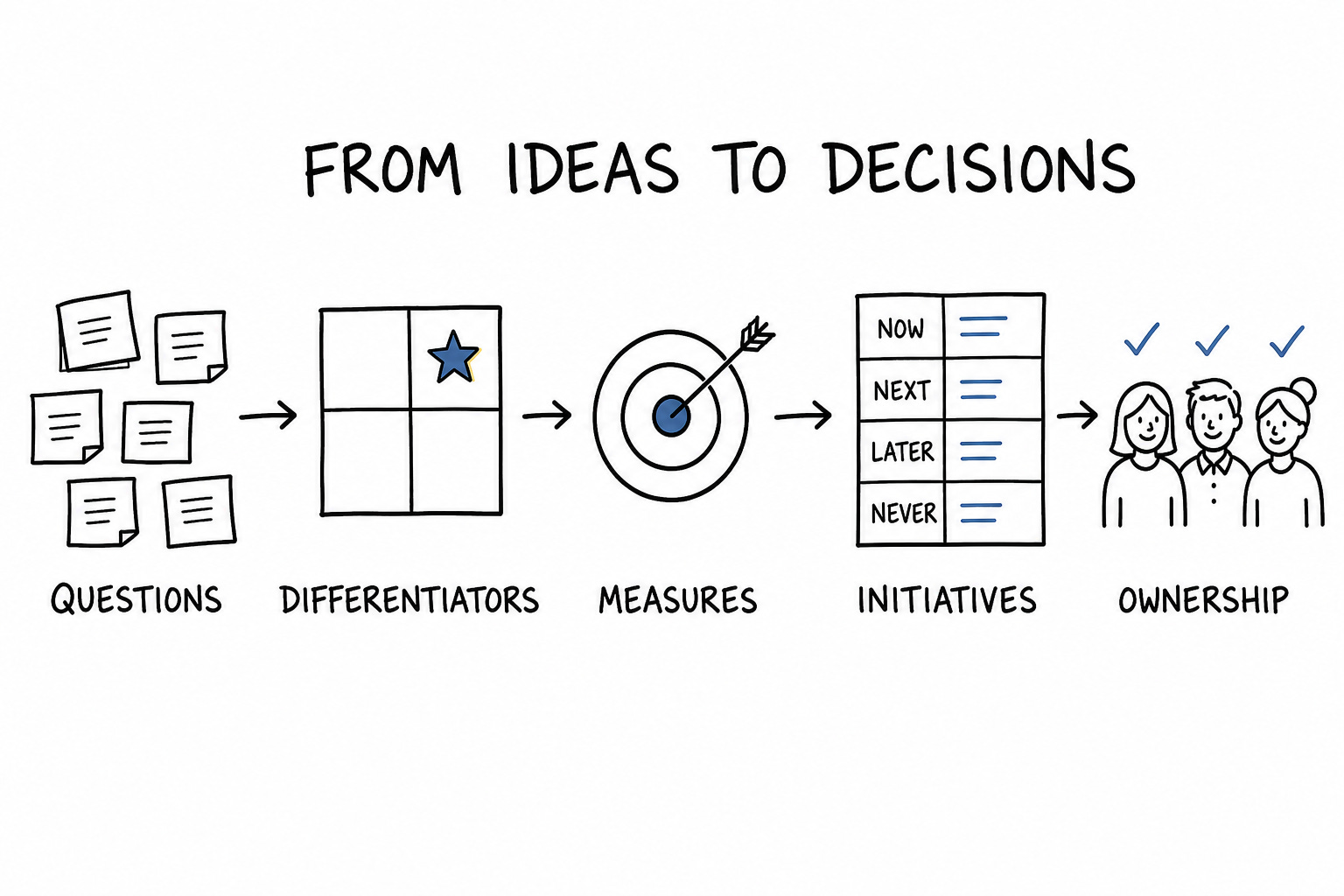
A high level view of strategy planning
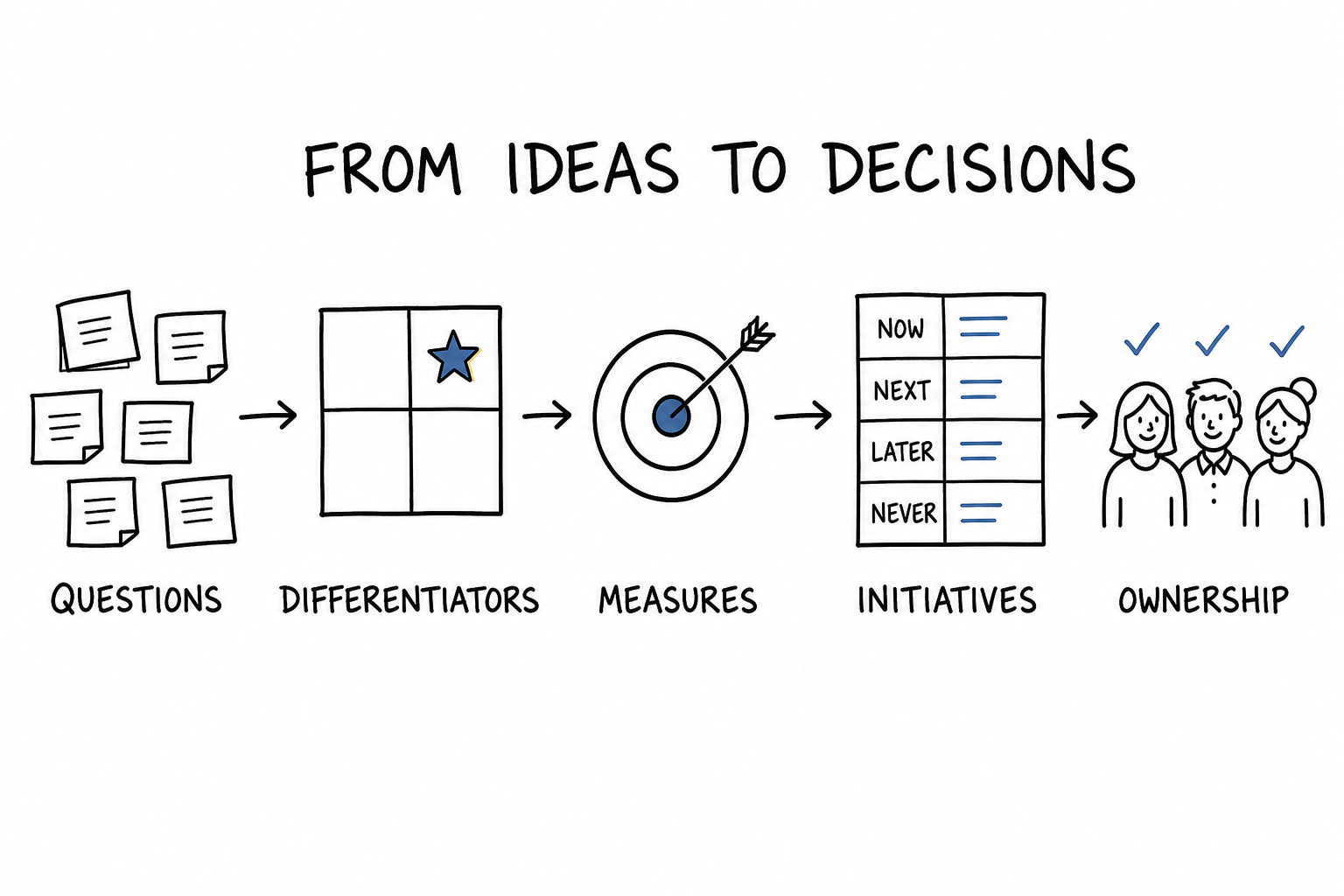
We used a few techniques I first learned about 17 years ago while co-authoring Stand Back and Deliver: Accelerating Business Agility.
First, we used the first four of the Six Questions to clarify our vision: who we serve, what they need, what we provide, and the best way to provide it. Then we used the Purpose Based Alignment Model to identify the handful of activities that could genuinely differentiate us in the market.
I also pulled out a couple of old agile-coaching facilitation techniques to help us generate ideas, challenge assumptions, and converge on decisions.
Turns out the techniques used for sizing user stories can be helpful after all.
With a clearer view of the vision and our competitive advantage, we set a three-year north star, a one-year north star, and four KPIs for marketing, sales, service, and our expert network.
Only then did we identify initiatives. We asked what we could do to move those measures, then put the resulting ideas on a Now, Next, Later, Never roadmap. Finally, we assigned owners and sanity-checked the work in Now to make sure the plan was manageable for the remainder of 2026.
That gave us a chain from vision to differentiators to measures to initiatives to ownership. The rest of this article walks through how we did it.
How we built shared understanding
Ask questions to build a vision
I have to admit it felt a little repetitive to have a discussion about vision. After all, the leadership team has grown over the past year to specifically make the owner’s vision happen. We all thought we knew what the vision was.
And as I’ve discovered countless times before, just because everyone on a team understands the vision doesn’t necessarily mean they have a shared understanding.
The purpose of the initial discussion was to build that shared understanding.
To guide our conversation toward shared understanding, we used Niel Nickolaisen’s Six Questions. Well, at least the first four:
-
Whom do we serve?
-
What do they want and need most?
-
What do we provide to help them?
-
What’s the best way to provide it?
In the before times when everyone was always in the same room, I would’ve facilitated this conversation with sticky notes and sharpie markers (InsideProduct branded of course).
This time around, there were five of us in the room and one joining remotely. Thankfully, technology has advanced over the past 15 years so we were able to make it feel like she was in the room with the help of some small mics, a camera, and Lucidspark.
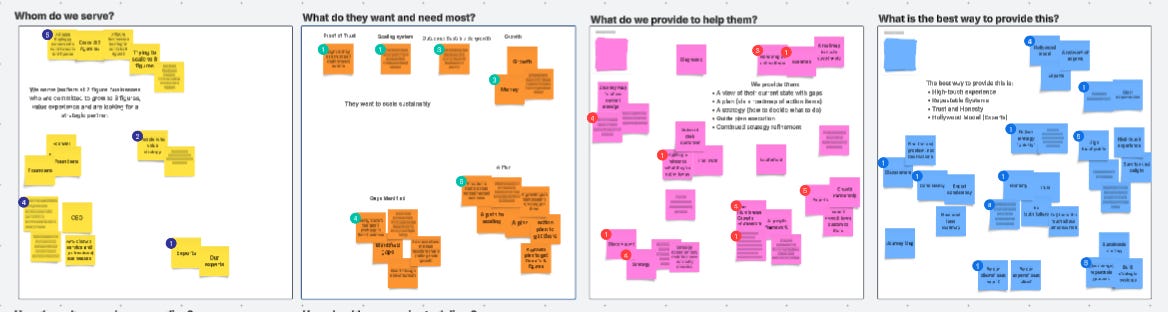
For each of the first four questions, we used Lucidspark to generate ideas on virtual sticky notes, group them, and then vote. That tried-and-true process helped us diverge on a lot of ideas and then converge on a shared answer to each question. It also gave people a chance to think on their own and provide their ideas without having to talk about each one.
The discussion we had processing the groups that got the most votes drove the shared understanding. For each question we coalesced the thoughts into a shared answer.
And while I won’t tell you the exact statement we came up with (I’m not drawing the curtain that far back) I can tell you what the answer to each question provided:
-
Whom do we serve? Helped us identify our ideal customer profile (ICP). Who we aim to serve and who we don’t.
-
What do they want and need most? Our ICP’s need that we’re in the best position to satisfy.
-
What do we provide to help them? The outcomes our services deliver to help them satisfy their needs.
-
What’s the best way to provide it? The distinctive ways we deliver those outcomes.
There were some interesting pivots while we discussed these questions. While we talked about whom we serve, we actually spent the most time talking about whom we don’t serve in order to find our best fit clients. We all agreed that we wanted clients who would work with us in a partnership, rather than clients that just gave us a to-do list.
The answers to what we provide to help them started out as a mixture between specifically named products and services and the outcomes those services provide. As we discussed the big vote winners, we realized the best answer to the question was the outcomes our services provided, because that’s more meaningful for our customers.
Following on from the choice to describe outcomes, the answers to what’s the best way to provide it made the most sense to describe in terms of how we delivered those products and services. This also led nicely into our discussion about our competitive advantage.
I mention those pivots because we didn’t initially start there. It was only through being willing to challenge each other’s ideas in a constructive way were we able to honestly land on what we were actually trying to say. It’s a lot messier than generating a lot of ideas and filling a Mad Libs template, but the result is a lot more useful.
This is familiar territory for product teams. Before deciding what to build, a product team needs a shared view of the customer, the need, the outcome it’s trying to create, and the approach it believes will create an advantage. Company strategy operates at a different altitude, but the facilitation problem is much the same.
We’re not an agency, and here’s why
The answers to those four questions gave us a clearer picture of our vision. But we still needed another guardrail to help us determine how we approach the various activities we perform as a business.
That’s where the Purpose Based Alignment Model, also from Niel Nickolaisen comes in. It’s a method for aligning your business activities around purpose as described by two criteria:
-
Mission critical: is it important that we do this?
-
Market-differentiating: will this differentiate us in the marketplace?
You can use these criteria to group your business activities in one of four quadrants.
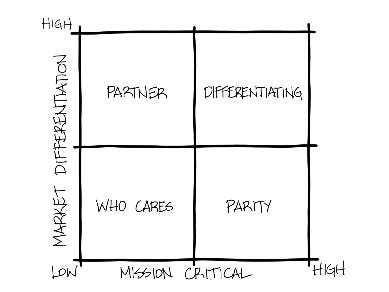
Classifying your business activities this way helps you apply the right amount of effort to them. You want to be innovative and creative when you deal with the small number of differentiating activities you have because these are the items that separate you from your competitors.
Conversely, for the vast majority of the parity activities you have, you want to do them as well as the leaders in the industry, but no better. This can save you time and effort by knowing you don’t have to do them better than your competitors.
For this exercise I asked everyone to create virtual sticky notes for all the activities we could think of. Because we expected duplicates, we grouped them and created a single virtual sticky for each activity.
Then we dumped the activities in a pile and worked through them round-robin using a technique I first used in the Risk Management Game. On each person’s turn they could place an activity, move one that was already placed, or pass.
We kept going until everything was on the model. Then we kept going until everyone had passed. A pass meant “I don’t see anything I’d move.”
That second lap was where the tough decisions and difficult conversations happened. Putting an item somewhere is easy. Moving a leader’s favorite initiative out of differentiating is harder. To help ensure we built shared understanding, we had one main rule: If you move an activity, say why.
That kept the sorting from going silent and private. Every move came with an argument out loud, which is the entire point. Someone would say, “This is essential to delivering what we promise, but customers won’t pick us because of it.” That’s parity work. Or, “We’re good at this, but so are our best competitors. We keep doing it, but it’s not where the strategy lives.” That’s also parity.
At one point the differentiating quadrant held 20 activities. Twenty differentiators don’t help a team make decisions, because when seemingly everything is differentiating, nothing is differentiating.
That was my cue as a facilitator to call that out and say we’ve got some things to move.
To pressure-test some of those “differentiators” we used the billboard test. Basically, for each activity categorized as differentiating, would we buy a billboard along the highway to advertise it?
If the answer’s no, the activity might still be important, but it’s not differentiating.
The billboard test is handy because it lets you push on an item without pushing on the person who cares about it. Instead of “that’s not strategic,” which nobody enjoys hearing, you ask whether the company would credibly lead with it in the market. It stops being about whether someone’s work has value and becomes about which work explains why a customer picks you over the shop down the street.
By the end, six items were left: four activities and two perspectives. That we could work with.
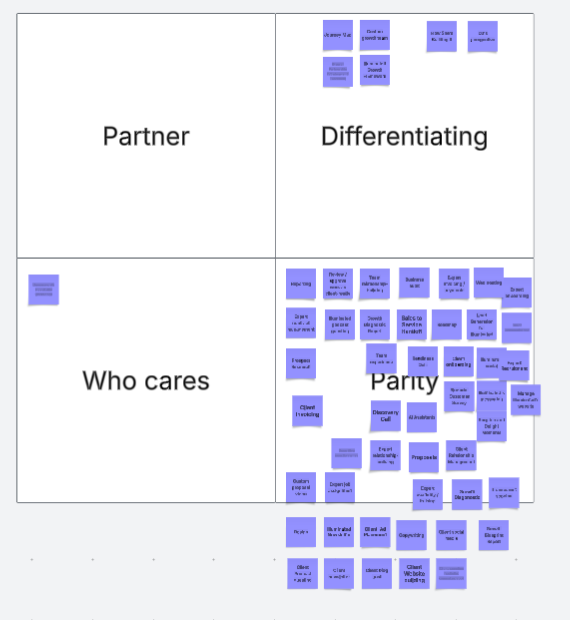
I should comment on those two perspectives. Those two perspectives weren’t activities with owners and workflows. They’re sets of principals we follow to approach our work with clients. If every strategic choice has to become an activity, teams miss the principles that should shape every project.
Use measures as decision filters
With our vision and competitive advantage identified, we needed a way to tell whether we were making progress and when to correct course.
We set a three-year north star to define the outcome we were aiming for. Then we set a one-year north star for the end of 2027, a nearer-term target that would tell us whether we had laid the groundwork to reach the three-year goal.
We also chose four KPIs for marketing, sales, service, and the expert network. The north stars described the outcomes we wanted to reach. The KPIs gave us more immediate signals about whether the work in each area was moving us in the right direction.
We set the one-year north star as a way to know at the end of 2027 that we’d set the proper groundwork to meet our three-year north star.
We then picked four KPIs, one each for four key areas of our business: marketing, sales, service, and the expert network. We identified the measures based on what needed to happen in each area to get us to the north star measure. We set the number based on a model with specific assumptions about what needed to happen to get us there.
I’m pretty sure there’s a spreadsheet somewhere that allows us to model different scenarios based on what those KPIs end up being. I do know we’re tracking the KPIs in our HubSpot dashboard.
Once we had the North stars and KPIs, and only then, did we identify initiatives by asking this question:
What could we do that would move these?
That question generated a pile of virtual stickies representing initiatives. We went through the pile of initiatives with the same facilitation technique that we’d used for the activities. This time around, we placed them on a Now, Next, Later, Never roadmap.
I usually keep Now, Next, Later, Never intentionally relative, but we gave each column a time horizon for this exercise to make the choices more concrete.
-
Now: The remainder of 2026
-
Next: In first quarter 2027
-
Later: In the rest of 2027
-
Never: we ain’t gonna do it. Ever.
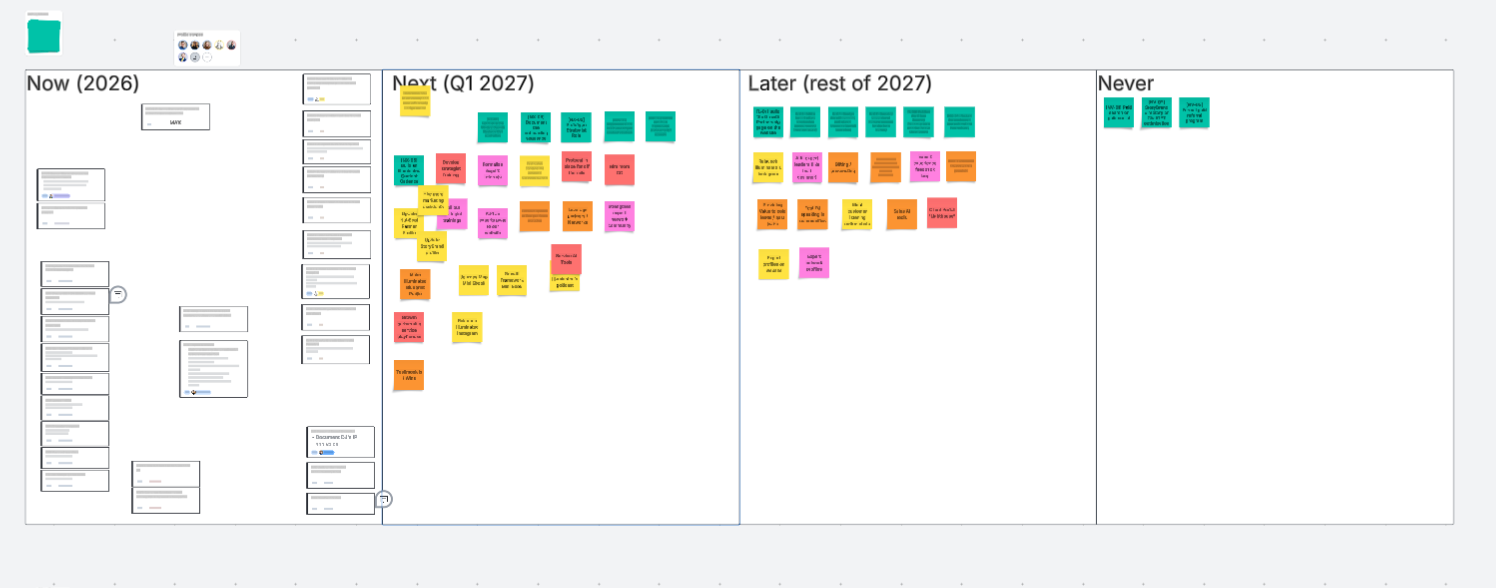
We had a few virtual stickies end up in Never, and I attribute that to the fact we used our north star and KPI’s as an initial constraint. We didn’t dream up initiatives that were irrelevant to our vision in the first place, which reduced the number of things we had to categorize. What few initiatives that did end up there seemed like a good idea initially, but when we discussed them, it became clear they were a distraction.
A roadmap without a Never column quietly morphs into a storage unit for deferred commitments. Every idea lives forever, and being visible starts to pass for being a priority. The Never column gives the team permission to identify an initiative we explicitly agree we won’t do.
Once we placed all the initiatives in a column we went through the items and identified an owner. We did that first because while we’d like to think we could do a lot of things still in 2026, we had to see who was involved. That additional piece of information helped us right size the number of items in Now and move some back to Next, or even Later.
This is the point where our strategy session generated an initial plan.
Your real job is protecting the tradeoffs
The most useful thing I did that week wasn’t introducing Lucidspark, dot voting, a four-quadrant model, or a roadmap. It was guiding the team through the moments where they had to actually give something up.
In practice that was:
-
Stopping after each of the first four questions to lock in one shared answer.
-
Making people say why they moved an activity.
-
Pushing back when the differentiating quadrant ballooned to 20.
-
Using the billboard test to identify parity activities disguised as differentiating.
-
Assigning owners and checking whether the work in Now was sustainable.
Good facilitation doesn’t make disagreement disappear. It allows disagreement to be productive. The win was never everyone leaving thrilled. The win is a plan people can live with, get behind, and still hold onto when the next hard decision shows up.
If you’re a product owner, business analyst, or product manager, this is most of the job whether it’s in your title or not. You help people see the decisions in front of them, sort preferences from priorities, and go from a long list of reasonable ideas down to a short list of commitments.
The tools help. Hybrid ones are often just necessary. But the real work is getting a group to accept that strategy is subtraction. After all, strategy is not a list of things to do, it’s a guide to deciding what you won’t do.
A sequence you can steal
Are you facilitating something similar soon? Here’s a quick overview of key tips:
-
Use questions to surface the raw material before anyone starts arguing about solutions, projects, or metrics.
-
Let people generate ideas on their own before the group weighs in.
-
Group, vote, talk, then consolidate into a shared answer before you move on. Don’t skip the consolidating. That’s where the magic happens.
-
Make explicit choices between mission-critical parity work and the stuff that truly sets you apart.
-
Make people explain their moves out loud, so the reasoning is in the room instead of in someone’s head.
-
Test every claim of “this is differentiating” with the billboard test.
-
Keep sorting until everyone passes, not just until every item has landed somewhere.
-
Name the future you’re chasing, then the measures that’ll tell you it’s getting real.
-
Turn it into initiatives: sequence them Now / Next / Later / Never, give each an owner, and size the work to the runway you actually have.
The tools mattered, but none of them did the hard work for us. The hard work was making tradeoffs visible, asking people to explain their reasoning, and staying in the conversation long enough to turn a list of activities into decisions the team could stand behind.
That’s a big part of the job for product owners, business analysts, and product managers, whether facilitation appears in the job title or not. We help groups see the decisions in front of them and leave with a smaller set of commitments that people can actually carry out.
Strategy isn’t a list of things to do. It’s a guide for deciding what you won’t do.
What facilitation technique have you used to help a team make a real tradeoff instead of collecting another list of good ideas?