Not every system request deserves innovation
Of all the factors that overwhelm system owners, there are two that are the most common and the most intrusive. The first one is too many requests for changes. The second one is the fanatical quest for innovation in your solution to those requests.
The second one is less well known and more insidious. Let me explain with a story.
I worked with a consulting firm to transition their CRM from Salesforce to HubSpot. They had realized that they didn’t need to use a sledge hammer to swat a fly. The problem is the consulting firm had really tricked out that sledgehammer.
The consulting firm primarily used their CRM to track leads and deals and they were very interested in measurement. Extremely interested. So in addition to tracking the actual fees they collected in Quickbooks, they also tracked anticipated billing in their CRM. In some cases they charged a lump sum per project cost. In others, they charged a monthly retainer, which in very rare cases may have a different monthly cost.
They tracked this anticipated billing in their CRM because they used it to create revenue forecasts for the current year and next year. In fact, they wanted precise estimates of how much the company would bring in each month, sometimes up to 18 months in advance.
Did I mention they were very into measurement?
What this all meant is that revenue tracking in Salesforce was extremely complicated. Each monthly bill for each deal was set up as a separate payment, even when it was the same dollar amount each month. They also created payments out for three years even though they renewed their retainer deals every year.
So when it came time to transfer this all over to HubSpot, my first instinct was that I had to figure out a way to rebuild that exact structure in HubSpot.
That instinct was wrong.
Complicated isn’t proof of purpose
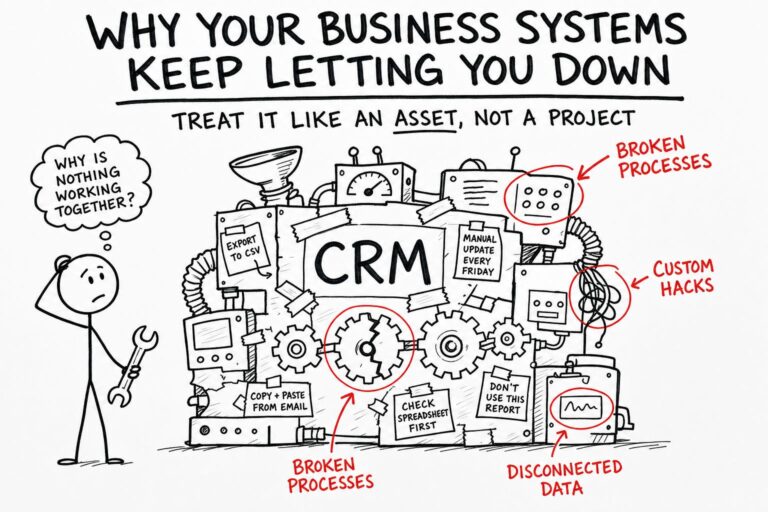
When you assume responsibility for a new system the natural tendency is to preserve its general structure and configuration. In fact, the more complicated the system is, the less likely you are to want to change it. Either because you’re afraid of breaking something, you reason that it’s complicated for a reason, or both.
I get it. I’ve been there.
Systems do not start out as complicated on purpose. Rather, they seem, as it were, to add feature on top of feature in a fit of absence of mind. And because they evolve seemingly randomly without a coherent plan, it can feel real risky to try and simplify it.
After all, if it’s not broken don’t fix it. And yet, moving a CRM from one platform to another provides an opportunity to simplify and some reasons to do so in case things go sideways. You could say that we’ve always realized that this was too complicated, so now we have the prime opportunity to simplify it.
Then, in some rare cases the system is actually complicated on purpose. Your company may get some competitive advantage from complicated logic. Maybe those complications allow you to deliver a service to your customers that’s more compelling than your competitors.
The trick is to know when you need something complicated or when you need something simple. When it makes sense to innovate and when you should match your competitors.
The purpose of an activity tells you how innovative to be
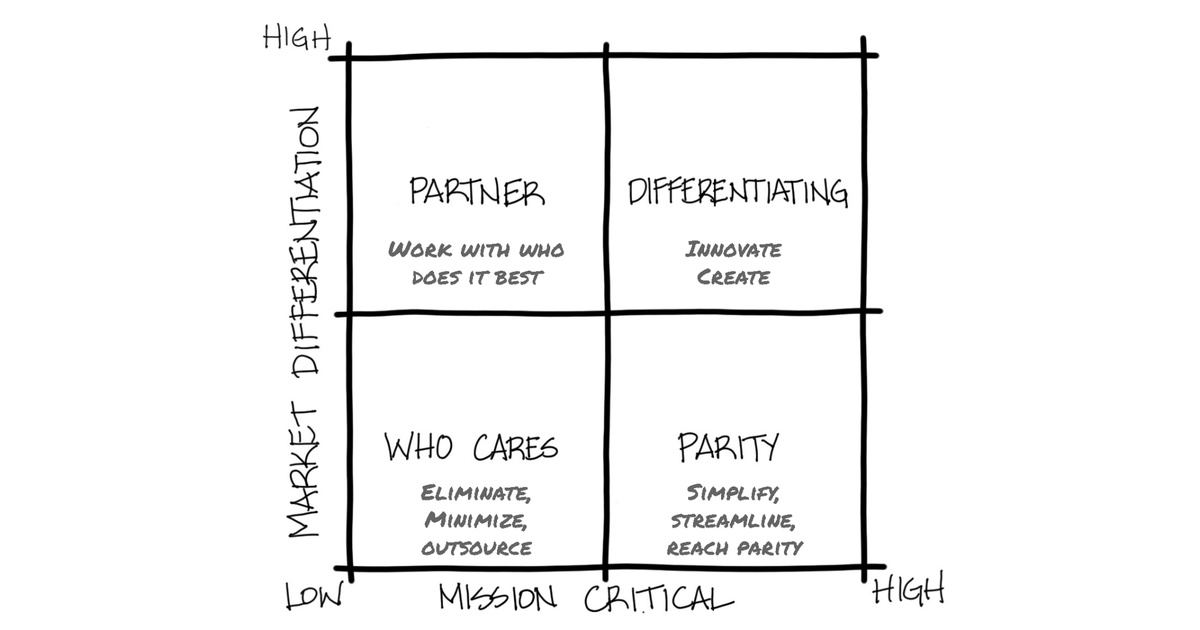
Enter the purpose based alignment model. Niel Nickolaisen, an IT leader and advisor created this model to align business activities around purpose. A small number of activities differentiate the organization in the market. Most other activities achieve and maintain parity with the market. The only activities where it makes sense to add a great deal of innovation are those differentiating activities.
The model is actually a 2×2 matrix where the x axis is mission critical – is it essential that your company does that activity? The y axis is market differentiation – does this help us generate market share?
Where an activity fits on those two axes places it in one of four quadrants which provides a guide for how to approach that activity.
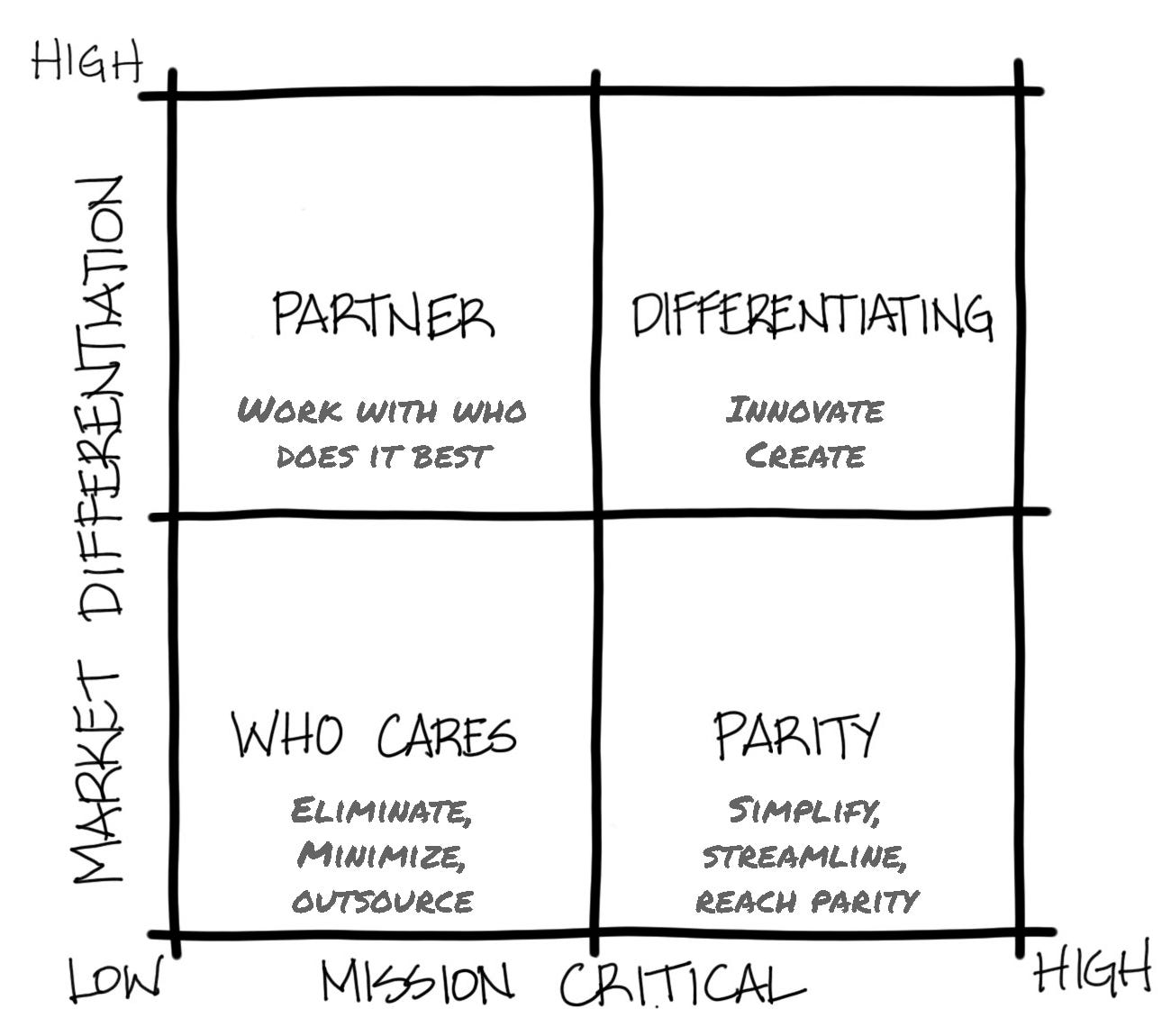
So taking that model into consideration, let’s take a look at the CRM conversion, specifically tracking multiple year revenue and forecasting.
It’s a standard business practice, sure, but it’s not what makes a client pick this firm over another. That combination puts it squarely in Parity, no matter how convoluted it was.
But just in case the finance manager is inclined to argue that “forecasting revenue is differentiating because… <mumbles into their coffee cup>,” remember that the odds are already against them. Most organizations only have one or two genuinely differentiating activities. Some don’t have any. So if someone’s declaring something differentiating, that’s a good time to pull out the billboard test.
In the billboard test, think about an activity you just declared differentiating. If it is truly differentiating you would not hesitate to include the activity on one of those billboards on the side of the highway. It would be the centerpiece of your advertising campaign.
So, can you imagine seeing a billboard that says, in effect “Buy from us, because we track and forecast our revenue for the next two years per month, down to the penny.”
Yep. tracking and forecasting revenue is a parity activity.
That means the consulting company should track and forecast revenue, but they didn’t need to do it any more extravagantly than other consulting companies. That means they could track expected revenue for the duration of a contract, and also assume their retainer deals had consistent monthly billing, treating those few cases that didn’t as exceptions. This dramatically simplified the setup of revenue tracking and allowed them to use existing HubSpot functionality and did not require creating month by month payments.
Use the purpose check to determine whether to be innovative with your activities
Here’s a quick check you can use to determine where your activities fit – no need to mumble into your coffee cup.
Step 1: Is it essential that we do this?
Yes: Your activity is on the right hand side of the matrix
No: Your activity is on the left hand side of the matrix.
Step 2: Does this separate us in the marketplace, or help generate new business?
Yes: Your activity is on the top part of the matrix.
No: Your activity is on the bottom of the matrix.
Step 3: Determine action based on where you land
Parity: Do we do this as well as our competitors? If no, that’s a parity gap — close it. (Don’t give them an excuse to brag about it)
Differentiating: Run the billboard test: would this ever actually show up on your company’s billboard? If it fails that test, move it down to Parity. (Keeps you from using a sledgehammer to swat at flies)
Who Cares: Can we get rid of this completely, or do we just need to minimize how much time and attention it gets? If nobody notices it’s gone, you have your answer.
Partner: For whom is this a differentiating activity? Find them, and let them own it. (Somewhere, their billboard is already bragging about this. Let them.)
Don’t innovate if you don’t have to
In my CRM transition example, we used the need to move from one CRM platform to another as an opportunity to simplify how the consulting firm tracked and forecasted revenue. It didn’t need to be as complicated as it was, but changing the approach without a compelling reason was too risky.
You don’t need to run out and audit every system this minute looking for unnecessary complexity. You probably already know where it is.
Keep the purpose check in your back pocket for the next time you touch a system, whether that’s a platform migration or a new integration. When that moment comes, ask whether what you’re about to touch is differentiating, or just complicated. Chances are it’s the latter.