The two types of product owners
I’ve often wondered if companies looking for product owners have a consistent understanding of what they’re looking for.
They don’t.
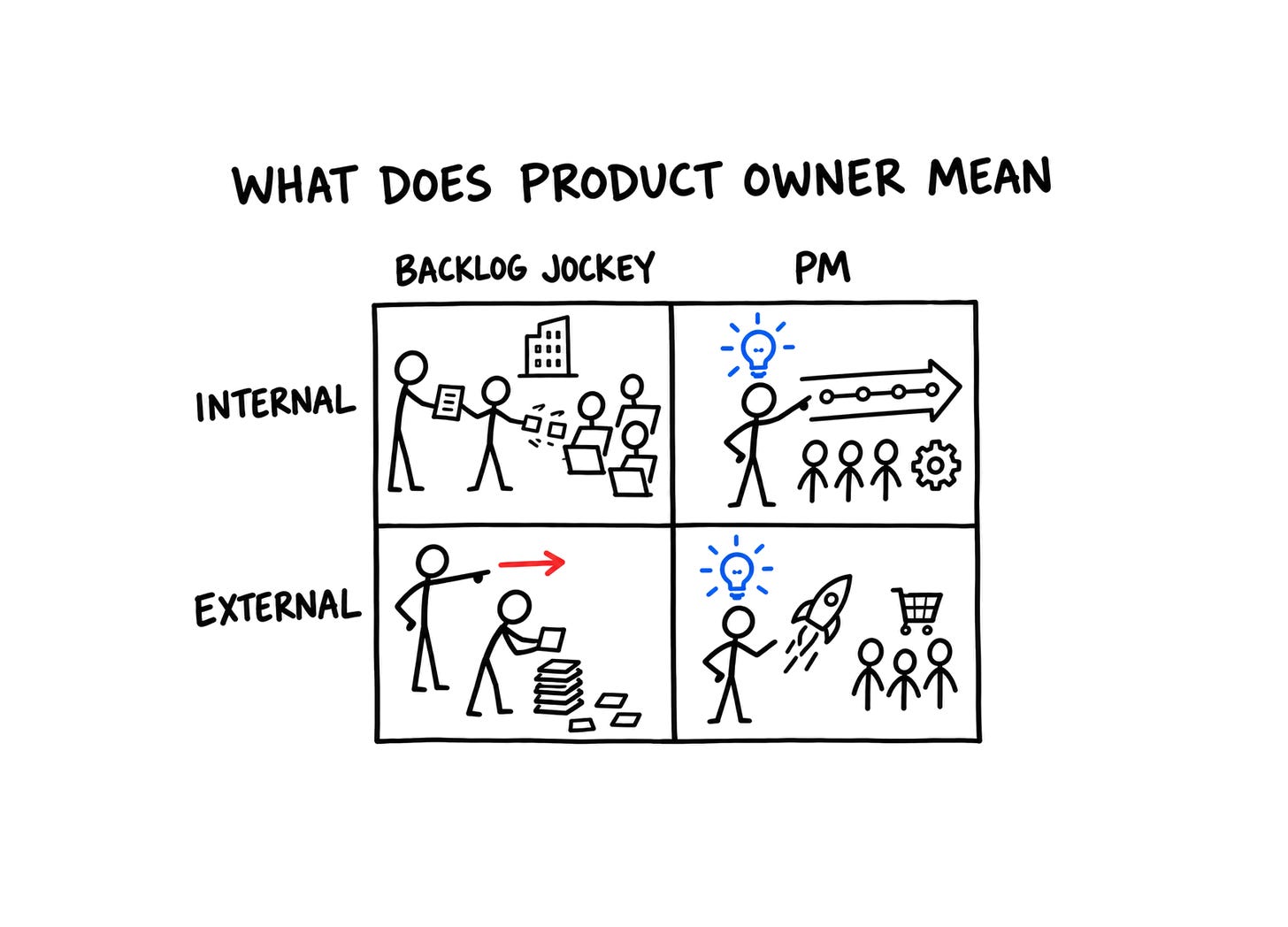
But the ways they differ follow a pattern. Based on a study of LinkedIn product owner job postings, product owners in an internal product setting tend to decide what to build and why.
In contrast, if you have a product owner job in a tech company that sells software, your focus is on delivery and there’s someone else who decides what to build.
Here’s how I came to those conclusions.
The assumption I wanted to test
I’ve worked with product owners at several organizations and have always marveled at the difference in expectations they all work under. Watching online discussions about product owners only confirmed the lack of consistent understanding.
I’ve suspected that what you’re expected to do as a product owner differs from company to company, and everyone assumes their definition of product owner is the correct one.
That makes talking about the product owner role with someone from a different company difficult, especially if you don’t clarify what shapes your perspective.
In order to confirm – or invalidate – that assumption, I did some original research of some sort.
In lieu of going around asking a bunch of companies for their job descriptions, I took the easy way out and used publicly available data. I saved product owner job postings from LinkedIn job alerts since August.
I ended up feeding 33 job descriptions to Claude to synthesize. It’s at this point that I was extremely grateful for functional AI because I was not looking forward to reading through 33 versions of job description haiku.
How I performed the analysis
To get the analysis started, I pointed Claude to the Notion pages where I had saved off the job descriptions. Here’s the prompt I used. And yes, the context of the question does impact the result you get.
I’ve been collecting product owner job listings from LinkedIn and storing them on this Notion Page [link redacted]
Please read through all the job postings and identify common patterns between the job descriptions and anything you notice about how different companies describe the role.
Feel free to ask me any questions you need to.
I should note the Notion page I pointed it to had some notes on it that Claude took into account when performing the analysis.
Premise (somewhat adopted from long ago): The product owner role has a lot of different shapes based on context; the type of company and how they have setup. This makes things complicated because when people talk about product owners, they may assume they’re talking about the same thing, but they’re not.
Initial findings
After a couple iterations where I had to ask Claude to actually read all 33 job descriptions, some patterns emerged.
Common responsibilities
Most of the job descriptions mentioned the common responsibilities you’d expect to see in a product owner job description such as:
-
Own the backlog
-
Write user stories
-
Write acceptance criteria
-
Work in Jira/Azure DevOps/backlog management tool of choice
Business analysis can get you in the room where it happens
A third of the postings (11/33) list business analysis as one of the backgrounds that qualifies you for the job. You’ll usually see it listed in a string of alternatives such as: “product ownership, product management, business analysis, or a similar role.”
Even though these 11 positions have some significant differences, they all treat business analysis as a legitimate path to a product owner role. That tells me a good chunk of the job is work business analysts already do, such as eliciting requirements and building a shared understanding about what the team is being asked to do.
I found it interesting that this came through in the job postings since it mirrors my own experience of coming up through business analysis.
You see? Business analysts are product people too.
Borrowing from the Scrum Guide
Several job descriptions pulled language straight from the Scrum Guide. That didn’t really come as a surprise given the role of Product Owner originated with Scrum.
Unfortunately some of them borrowed words that don’t fit their situation. I don’t think they mean what they think it means.
As an example, six job descriptions identified the product owner as the “voice of the customer.” At least three of those were for internal tools, so the product owner was really the voice of other folks in their company. (See What is the difference between customers, users, and stakeholders for more insight into why this matters)
Who decides what to build
Another key divergence in the postings is whether the organization expects the product owner to decide what to build and why.
Of the 33 postings, 20 include decision making as an expectation. In most of those, the product owner owns the typical product management responsibilities, from setting direction to writing requirements. In fact, you could say that these product owners are product managers with a different name.
Twelve other postings treat the product owner as supporting another role that makes the “what are we building” decision. Two say so outright, naming a product manager or director who owns it. The rest rarely ask the product owner to set direction and focus on managing the team’s backlog. You could call these positions backlog jockeys.
The 33rd posting is an outlier. More on that in a minute.
Context in a 2×2 matrix
I certainly didn’t set out to create a 2×2 matrix with this analysis, but boy was I excited when I saw the opportunity to create one.
Because who doesn’t love a good 2×2 matrix?
The grouping isn’t perfect, but if you squint a little bit, you can organize the job postings into four groups, defined by internal vs external products (one factor of context) and product manager vs backlog jockey (whether they own the what to build decision)
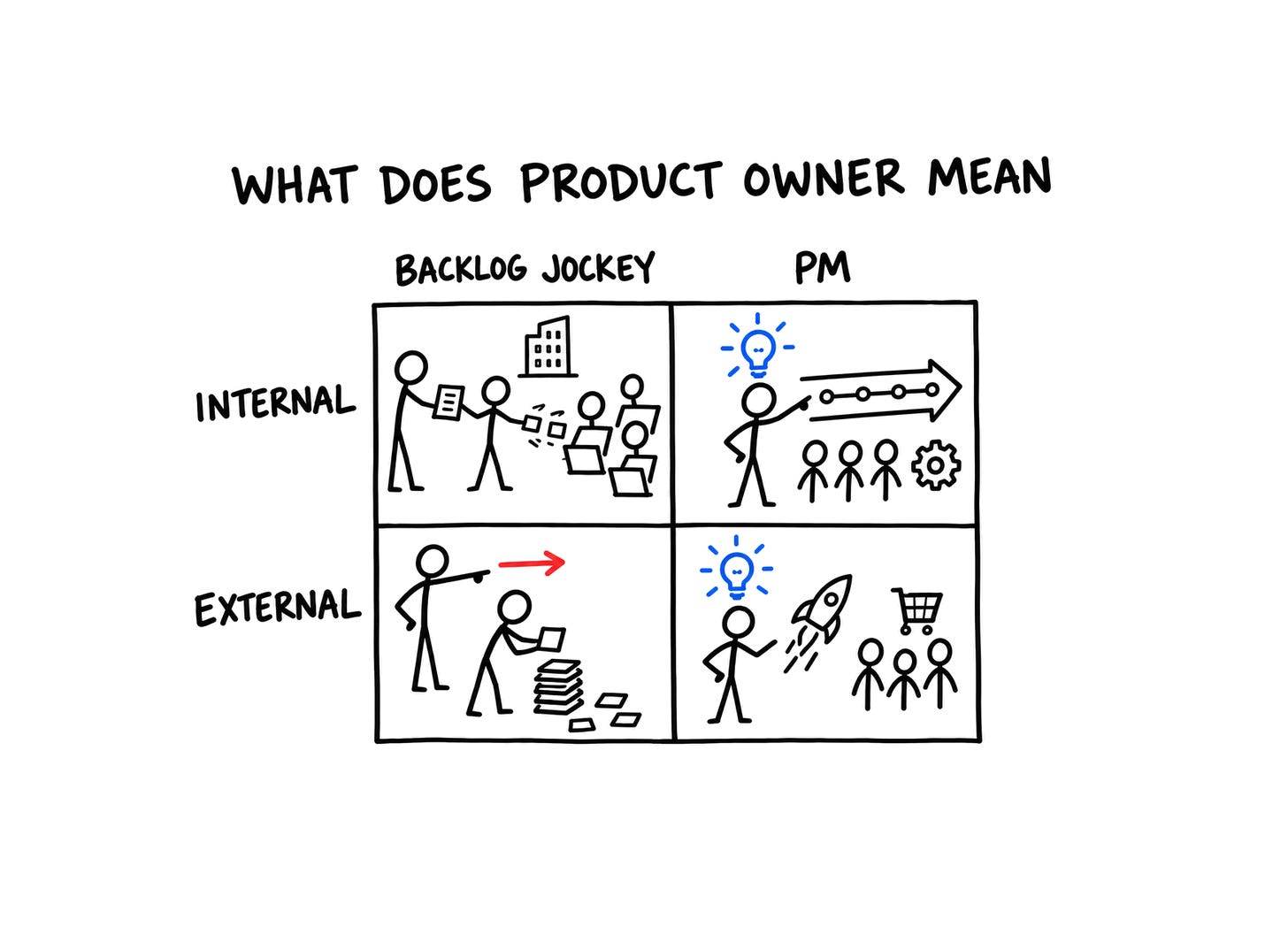
Internal products are software a company buys or builds for its own business. External products are software it sells. It’s possible Claude was primed to notice this difference due to my focus on internal products. Or it’s possible the difference stood out to me because I suspected there was one.
Here’s how the numbers shook out.
Note that a significant majority of product owners in internal product settings act as product managers (16 out of 19).
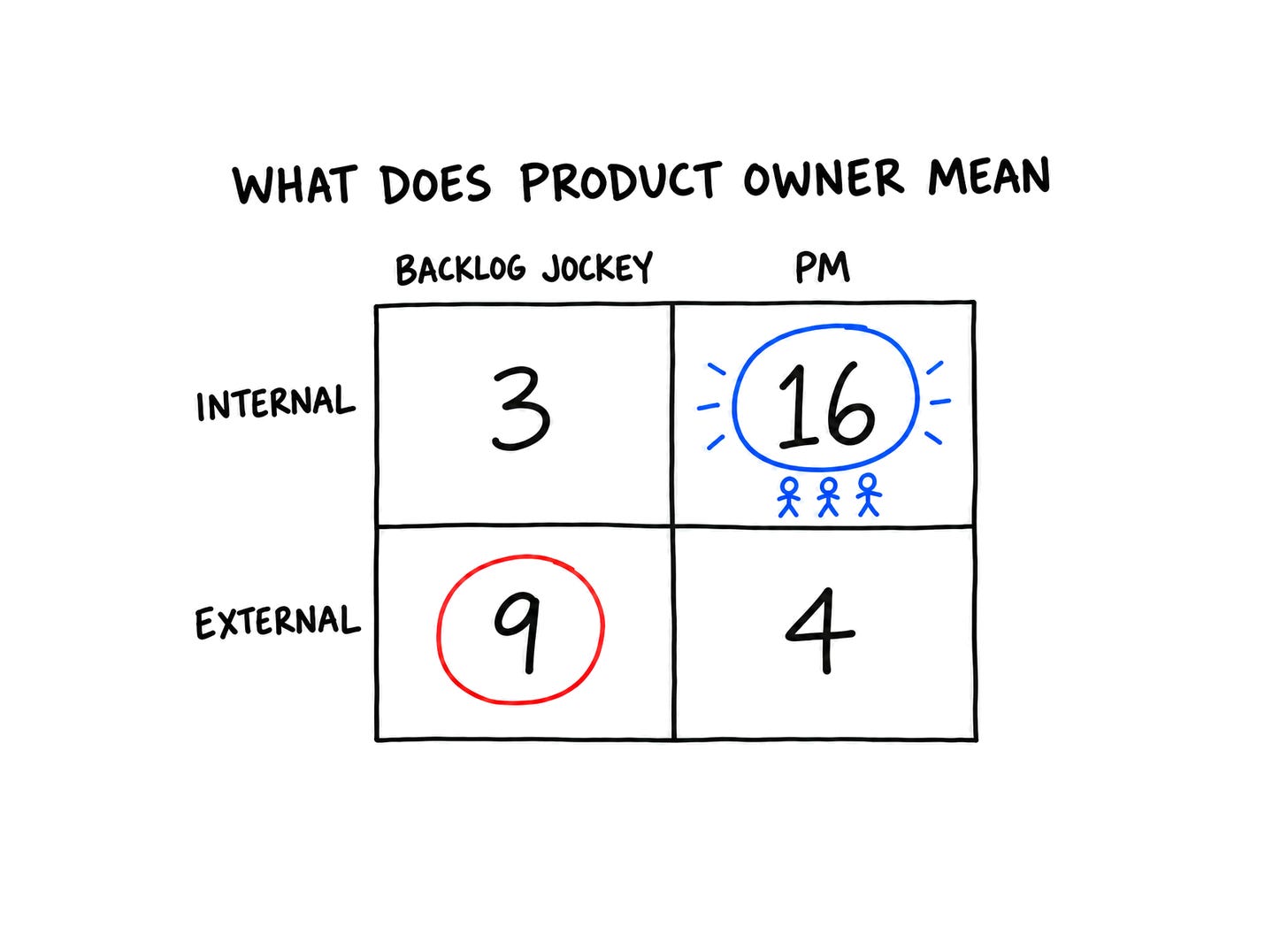
I suspect this happened because these organizations adopted Scrum back in the day, so it made sense to call the person who decided what to build a product owner. The idea of applying product management practices to internal software is relatively new, and the product owner title had already gained traction.
That fits a suspicion I’ve had for a while, that a product owner in an internal product setting is (or is likely to be) the product manager. The postings are consistent with it, but they can’t prove it.
On the external side (products for sale), 9 of the 13 postings read like backlog jockey jobs. It looks like those organizations split a focus on delivery apart from the people deciding what to build, ie “real” product management.
The one outlier
Now if you’re one of those people and bothered to add up the numbers you’re probably saying “but Kent, there’s only 32 there. What’s up?”
The one outlier is a services firm that builds AI products for education and publishing clients. They’re looking for a…wait for it… Forward Deployed AI Product Owner.
If there was ever a case of keyword stuffing a job title…
I didn’t include the job in the counts on the 2×2 because it just didn’t fit any of the categories and it seems more like a consultant than a product owner. Or perhaps even a unicorn. Just take a look at the job description.
Unlike a traditional Product Owner, this role sits at the intersection of consulting, product management, AI, data strategy, and customer success. You will embed with customers, understand their business processes, identify opportunities for AI transformation, define product requirements, and lead delivery through an AI-first SDLC.
That’s one heck of a Venn diagram.
Think twice about discounting the product owner title
The product owner role has more than its share of detractors.
You’ll often hear folks, especially in the product management community, say it’s a pointless role. My guess is they’re thinking of an external product setting and the product owners they’re thinking of look a lot like the backlog jockeys I described above. And in that case, they may have a point.
But if the product owner you’re talking about is in an internal product setting, chances are they resemble a prototypical product manager. The reason they have the product owner title is due to the organization using scrum before applying product management in an internal product setting became a thing.
Keep in mind this is based on 33 LinkedIn postings since August, so your mileage may vary, especially in a different industry or region.
If you’re a product owner, hit reply and tell me whether you’re doing product manager or backlog jockey work and whether you work on internal or external products. I’m curious whether it matches what I found.