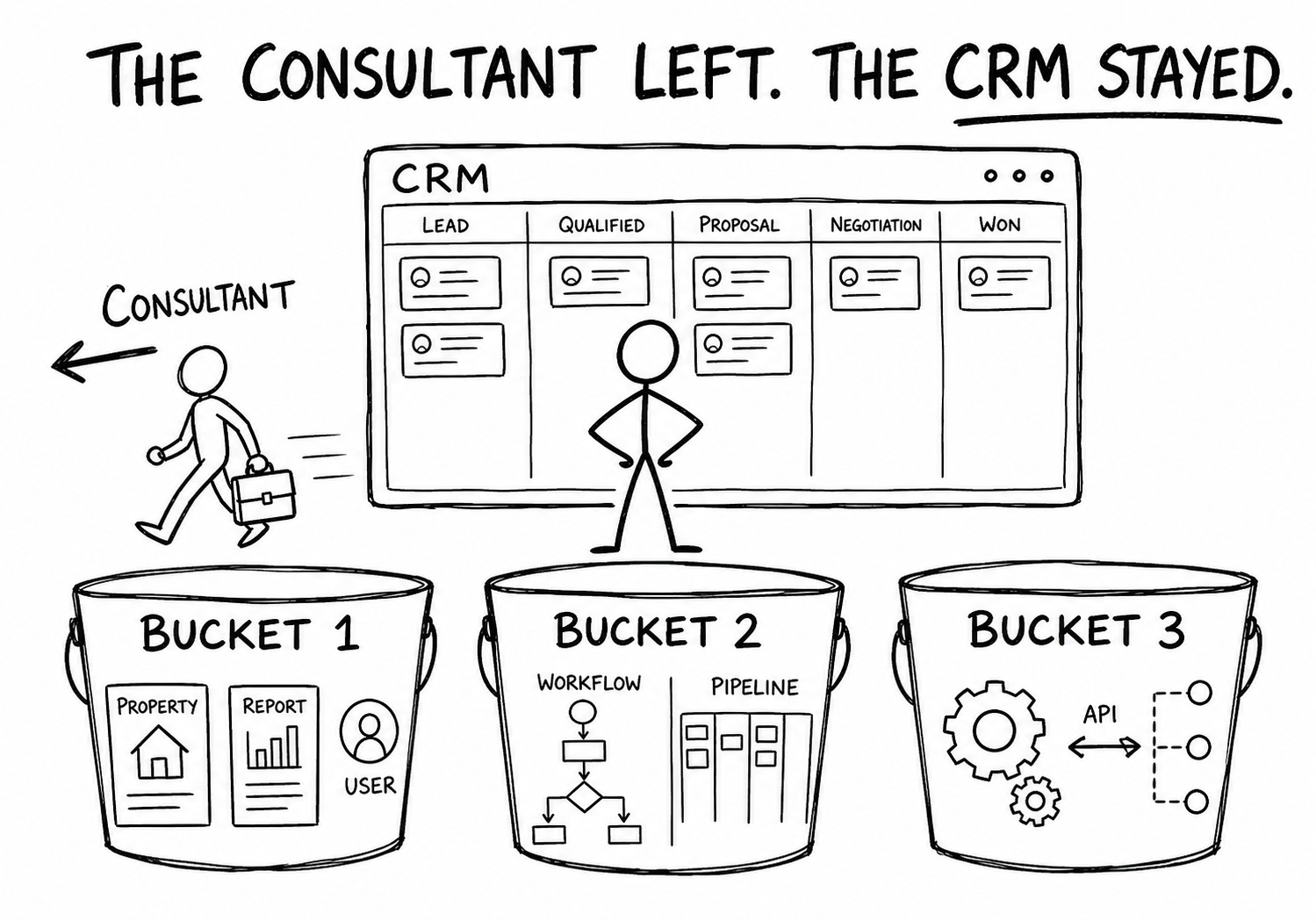
The consultant left. The CRM stayed.
Deep down in places you don’t talk about at parties, you already know the answer is you.
Every time a pipeline stage needs updating, a workflow breaks, or a report stops making sense everyone in the room looks at you. You own the system. Nobody said it out loud. It just happened.
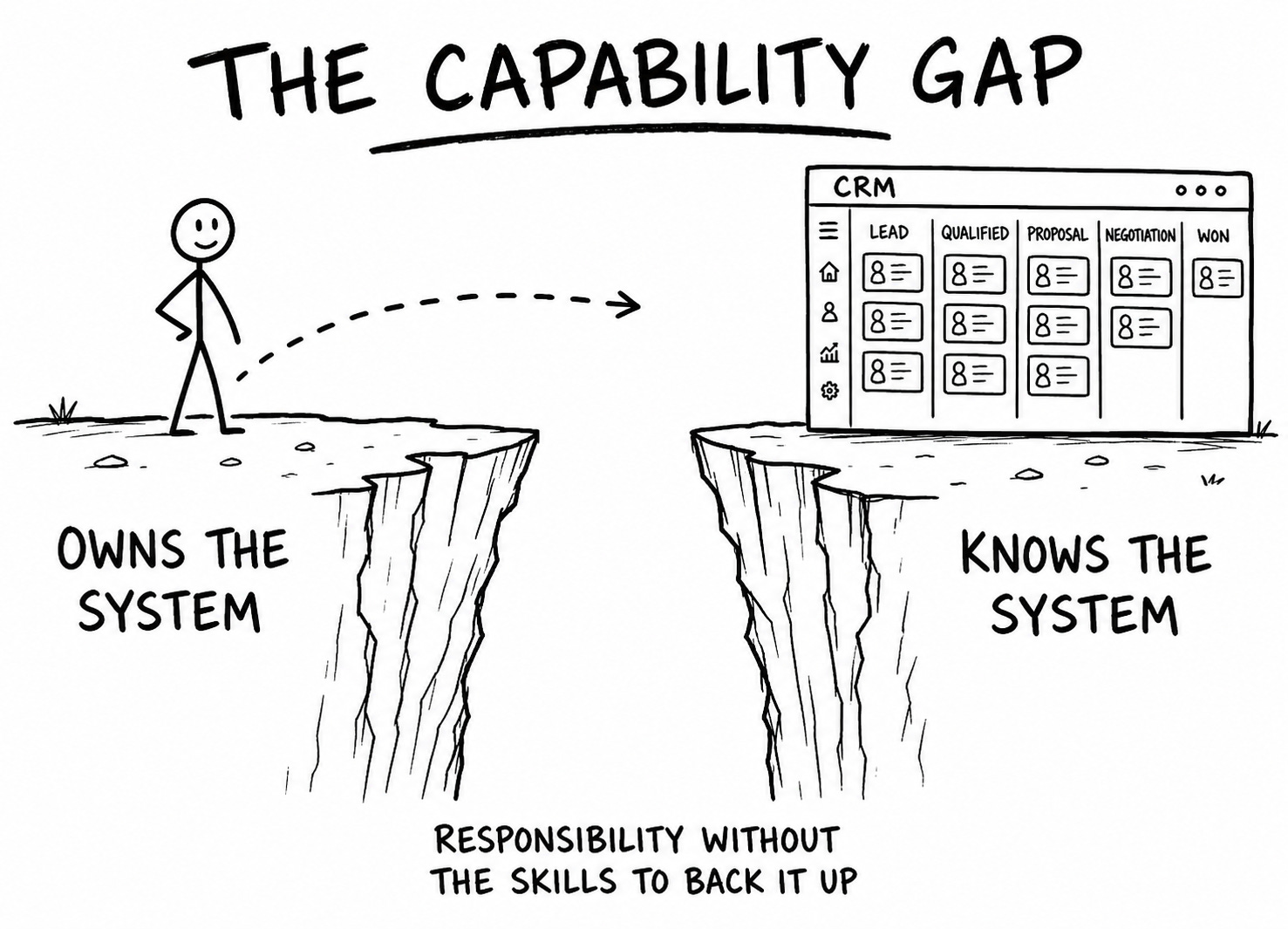
Knowing you’re responsible and knowing how to actually do the work are two very different things. And right now, there’s a gap between them.
This is the capability gap. It’s the part of system ownership that nobody talks about, and it’s the part that turns a manageable role into a daily source of stress.
How the capability gap happens
Most capability gaps have the same origin story.
When your organization first set up your CRM, someone else did the work. It may have been a consultant, an agency, an internal IT team, or a capable admin who has since left. They configured the tool, built the workflows, and set up the reports. Whoever it was, they were good at it, and things worked.
You were the subject matter expert. They were the implementers. When the arrangement ended, that knowledge didn’t magically transfer.
This is typical of how most small and mid-sized businesses set up their systems. The person who knows the business and the person who knows the system are rarely the same person. Yet the person who knows the business is more often than not identified as the ongoing system owner.
When the tool-knower leaves, the system owner is left holding responsibility without the capability.
What do you actually need to know?
When system owners find themselves in this situation, they take one of two approaches: try to learn everything, or remain ignorant and try to weasel help from people who are no longer compensated to provide it. Neither approach is a recipe for success.
Trying to learn everything leads to hours of HubSpot Academy videos and a vague sense that you’re still not prepared for the actual request that just came in.
The right question isn’t “How do I learn this tool?” It’s “What do I specifically need to know how to do?”
Those are very different questions, and the second one is much more useful.
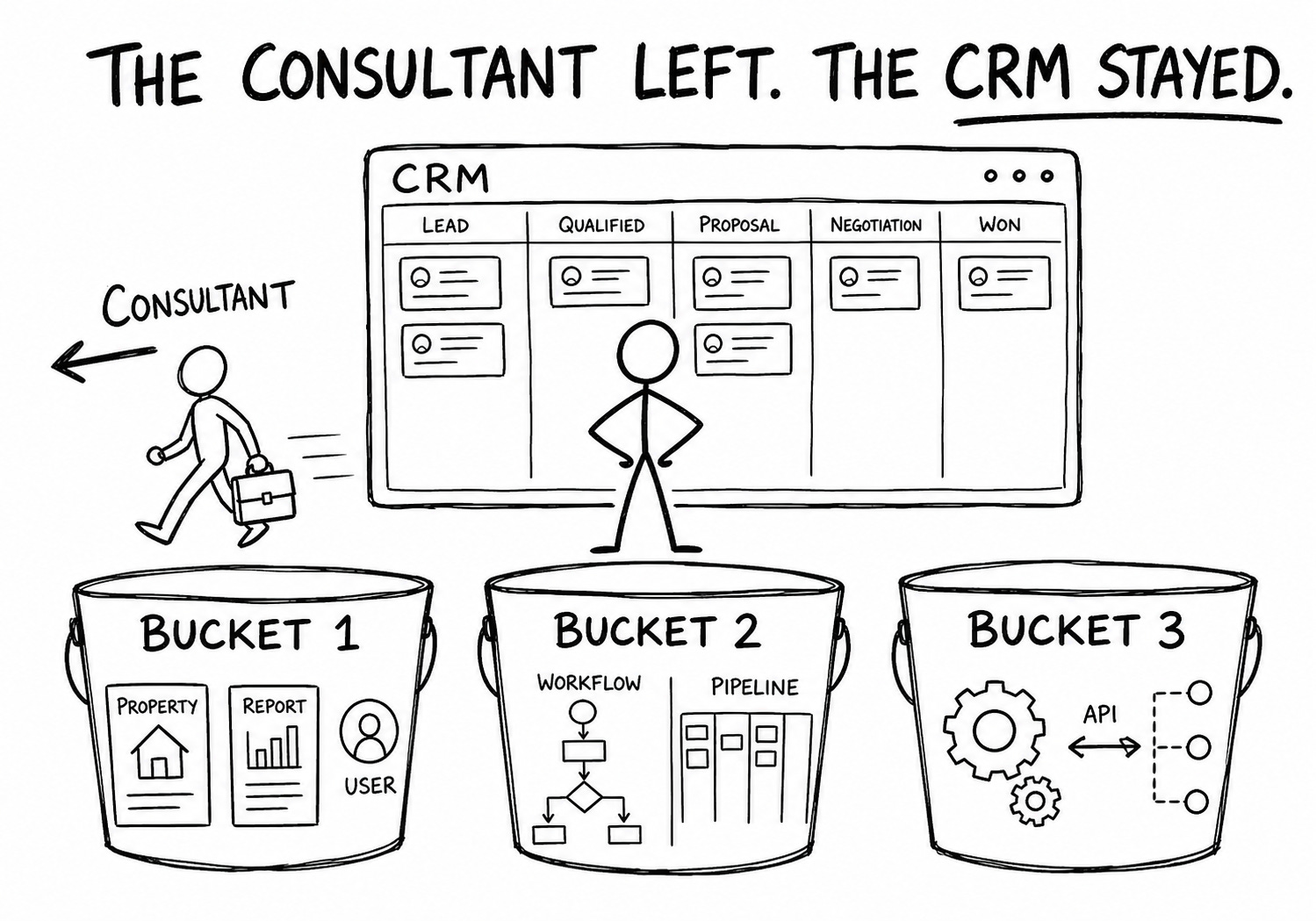
Start by separating the work into three buckets:
Bucket 1: Things that happen regularly and need a quick turnaround
There are some recurring tasks that shouldn’t require a ticket or a consultant. Things like updating a property, pulling a standard report, adding a user, or adjusting a pipeline stage are basic operational continuity. These are your must-learns.
Bucket 2: Things that happen occasionally and require more judgment
There are some tasks that you should understand conceptually. When you need to build a new workflow, restructure a pipeline, or diagnose why a report is showing unexpected results you should know what’s involved, roughly how long it takes, and what questions to ask. But you don’t need to execute them yourself every time.
Bucket 3: Things that are genuinely technical and belong with someone else.
Then there are the technically involved tasks such as custom integrations, API connections, complex data migrations, or advanced automation logic that touches multiple systems. These are legitimate candidates for delegation or outside help. Knowing where this boundary is, and being honest about it, is a trait of an effective system owner.
There’s a version of “this belongs with someone else” that’s entirely appropriate. And there’s a version that’s avoidance dressed up as delegation. The difference is worth a moment of honest self-examination: Am I handing this off because it genuinely needs someone else’s skills, or because I haven’t built confidence yet with this part of the tool?
Both are valid starting points. But they lead to different responses. The first calls for delegation. The second calls for a minor investment in building competence, which almost always pays back faster than expected.
You don’t need to become a technical expert to have a proper working knowledge of your CRM. You need to understand the tasks in the first bucket cold, understand your second bucket well enough to manage it, and have a coherent plan for your third bucket before you need it.
Bucket 1 in practice
Here’s what might fit into Bucket 1:
-
Add and edit contact, company, and deal properties
-
Create and update pipeline stages
-
Pull and change standard contact and deal reports
-
Add new users and adjust permissions
-
Edit an existing workflow (not build from scratch)
-
Understand what’s in each active workflow and what triggers it
-
Know which integrations are connected and who to call if one breaks
Most of those tasks are learnable in an afternoon of focused practice. All of them are within reach if you approach them deliberately rather than waiting for someone to hand you the knowledge.
The point isn’t to become a HubSpot expert. It’s to own the system in a real sense, not just hold the title.
How to close the capability gap
The most effective way to close the capability gap isn’t courses. It’s deliberate, low-stakes practice on real tasks.
Here are a couple of learning paths you can try:
Pick one recurring task and own it completely
When you have a new task to do from the first bucket, don’t delegate it or immediately ask for help. Just do it. Look up what you need to; try it in a sandbox environment if one exists; and work through it. Your first attempt at a new task isn’t about perfection; it’s about learning through experience. I accept that the first time I try anything, there’s a good chance I’ll mess it up. And the second time I do it I’ll be much more proficient.
Build a personal cheat sheet for your instance
Your CRM isn’t a generic HubSpot setup. It has specific pipelines, properties, workflows, and conventions that reflect your business. Documentation about those things doesn’t exist anywhere except in the heads of the people who built it. Start capturing it yourself: what each pipeline stage means, which properties matter and why, which workflows are running and what triggers them. This document doesn’t need to be formal. It just needs to exist.
Put that documentation directly in your CRM tool so you’ll know where to find it. HubSpot, for example, offers fields for pipelines, properties, and workflows. Use them.
Support plans are still worth it
The goal isn’t to get rid of outside help. It’s to stop being helpless without it. There’s a real difference between calling someone because the work genuinely exceeds your skills, and calling someone because you never tried.
Know which one you’re doing.
You’re not doomed to a big capability gap
The capability gap feels bigger than it is, mostly because it’s invisible until you need it. When the consultant was there, you never had to find out what you could do yourself. Now you do.
Start with one task. Own it completely. Go from there.
What’s the one thing you keep handing off to someone else because you’re not sure you should own it? Hit reply. I’m genuinely curious what that looks like for different businesses.